Departments & programmes
Explore NBTE-accredited National Diploma programmes offered by the School of Engineering. Select a department to view curriculum, admission requirements, and career outcomes.
Computer Engineering Technology
ND Computer Engineering Technology
NBTE National Diploma — curriculum, entry requirements, and career pathways.
View programmeCivil Engineering Technology
ND Civil Engineering Technology
NBTE National Diploma — curriculum, entry requirements, and career pathways.
View programmeElectrical/Electronic Engineering Technology
ND Electrical/Electronic Engineering Technology
NBTE National Diploma — curriculum, entry requirements, and career pathways.
View programme
NBTE-accredited programmes
- ND Computer Engineering Technology
- ND Civil Engineering Technology
- ND Electrical/Electronic Engineering Technology
Official titles from the NBTE programmes catalogue. Entry requirements and course lists are on each department page.
Why study with us
The School of Engineering at Redeemer's College of Technology and Management (RECTEM) trains technicians and technologists for Nigeria's infrastructure, power, manufacturing, and digital economy. Like leading federal and state polytechnics, we combine classroom theory with sustained workshop and laboratory practice so graduates can work safely and competently from day one on site.
Our departments—Computer Engineering Technology, Civil Engineering Technology, and Electrical/Electronic Engineering Technology—deliver National Diploma programmes aligned with National Board for Technical Education (NBTE) curricula. Students learn to read drawings, use instruments, install and maintain systems, and communicate technical information in teams, mirroring the expectations of employers across construction, utilities, and ICT sectors.
RECTEM is located in Redemption City, Mowe, Ogun State, with modern engineering workshops and laboratories that support hands-on modules in each semester. Through SIWES, students gain real workplace exposure before graduation, strengthening employability and professional confidence.
Academic pathways
Each department offers a National Diploma (ND) over four semesters of classroom, laboratory, and workshop training, followed by the Supervised Industrial Work Experience Scheme (SIWES). Successful graduates may progress to Higher National Diploma (HND) study or enter the workforce as engineering and technical professionals. Programmes follow NBTE-approved curricula and are subject to routine accreditation monitoring.
NBTE-accredited programmes
Every engineering ND follows an NBTE-approved curriculum with defined semester credit units, professional modules, and assessment standards. This ensures your qualification is recognised across polytechnics and employers nationwide—the same national framework used by Federal Polytechnic Bauchi, YABATECH, and other established institutions.
Workshop and laboratory training
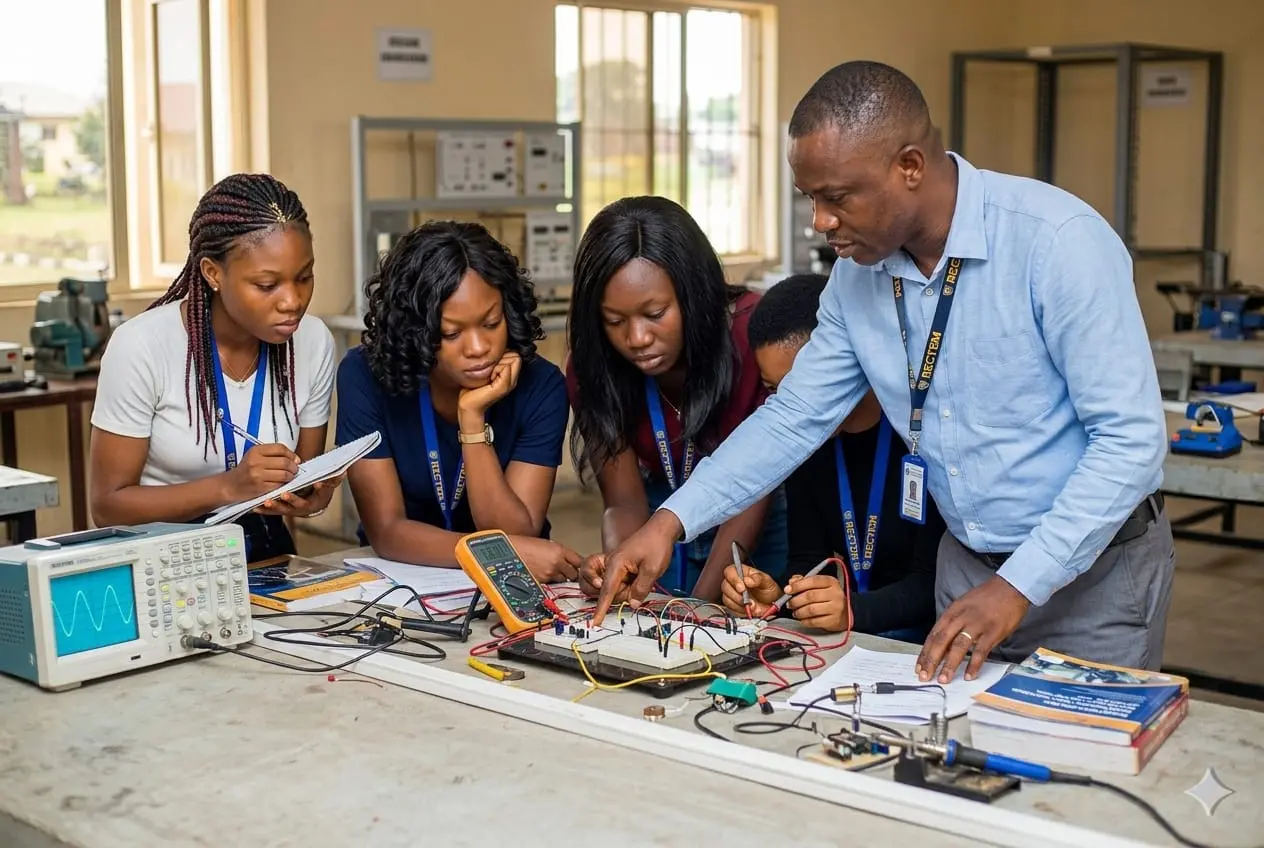
Engineering cannot be learned from lectures alone. RECTEM emphasises workshop practice, electrical and electronics labs, surveying exercises, and computer/engineering studios where students build, test, and troubleshoot real equipment. This practical depth is what distinguishes polytechnic graduates in hiring decisions.
Experienced faculty and mentors
Lecturers combine academic preparation with industry awareness, guiding students through calculations, codes of practice, safety procedures, and project documentation. Small-group teaching and continuous assessment help you receive feedback throughout the semester—not only at final exams.
SIWES and industry exposure
The Supervised Industrial Work Experience Scheme places ND students in companies, sites, and utilities for structured on-the-job learning. You apply classroom skills under supervision, build your CV, and often secure employment through placement networks—an approach standard at major Nigerian polytechnics.
Career-ready technician skills
Graduates support civil contractors, electrical maintenance teams, power distribution, telecommunications, and IT hardware operations. With experience and further study (HND or professional exams), many advance to supervisory, design-support, and specialist technologist roles.
Ethical and sustainable practice
RECTEM integrates safety, quality, and environmental responsibility into engineering training. Students learn to work within regulations, respect site procedures, and consider the social impact of infrastructure—values expected of technicians in modern Nigerian industry.